Domino Spiral
3D object3DSeamless loop16 seconds
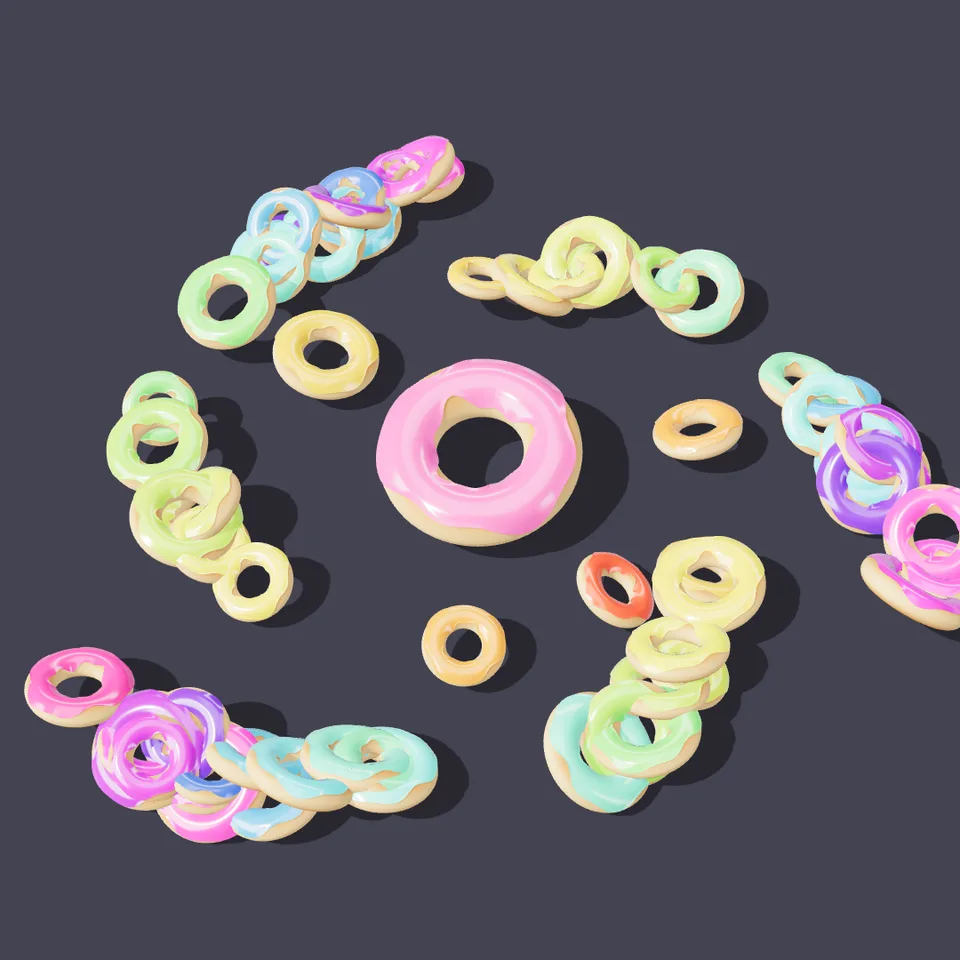
Dozens of rainbow-glazed donuts spiral round a big one at the centre like a galaxy, tumbling as they go. Loops perfectly.
In Space & cosmos, Food & sweets, Toys, games & parties, Patterns & illusions
Next: Domino SpiralSurprise me
Your current settings go with it. Combine several clips and hand them over together from your sequence.
Presets
The preview runs the same code your AI receives. These settings travel with the hand-off.
A galaxy made of donuts: dozens of small glazed donuts swirl round a big one at the centre along the arms of a spiral, the inner ones racing and the outer ones drifting, each tumbling as it goes and every glaze a different colour of the rainbow. Choose the number of donuts, the number of spiral arms, how strong the glaze colours are, how many laps the outermost donuts make per loop, the seed, the backdrop colour and whether the camera sways.
src/glazed-galaxy.js is the ingredient your AI reuses. demo.js is only the example scene around it, and uses chrome-material only for the demo.
src/glazed-galaxy.jscreateGlazedGalaxy({ count?, arms?, saturation?, laps?, seed? }) => { group, setProgress(progress), dispose() }three@0.185.1 (source) — Renderer, geometry and shader materials.chrome-material@1.1.0 (demo) — Studio environment light, backdrop and contact shadow.apw-runtime@1.0.0 (demo) — Demo harness.Coordinates: The big donut sits at the origin (height 1.1); small donuts orbit at radius 2.6–7.2 in the xz plane; the camera looks down at about 52°.
Lighting: A warm key light with a shadow map, a shadow-catching floor and the studio environment.
Timing: setProgress(progress) places every donut on its orbit; frames render in any order.
npm install
npm run render -- glazed-galaxy/1.0.0 --out my-video.mp4
Needs Node 18+, ffmpeg and Chrome/Chromium. Add --params my-settings.json (from Copy settings) for your own settings.sha256:323062582b53f6d6…3D object3DSeamless loop16 seconds
3D object3DSeamless loop12 seconds
Effect2DSeamless loop6 seconds
Effect2DSeamless loop8 seconds
Background3DSeamless loop12 seconds
Background3DSeamless loop12 seconds
Background3DSeamless loop14 seconds

Background3DSeamless loop16 seconds