Particle Galaxy
Background3DSeamless loop14 seconds
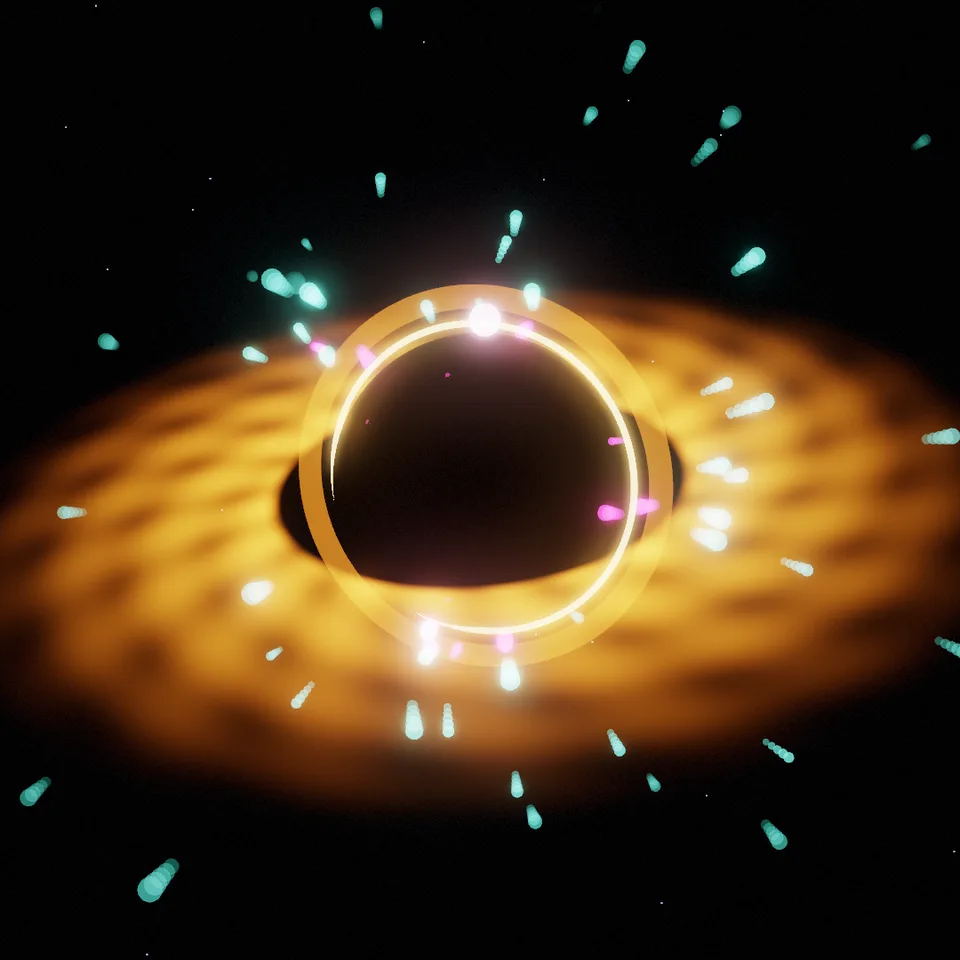
Particle pairs flash out of the vacuum at a black hole's horizon: one escapes, one falls in, and the hole shrinks. Loops perfectly.
Your current settings go with it. Combine several clips and hand them over together from your sequence.
Presets
The preview runs the same code your AI receives. These settings travel with the hand-off.
A black hole that slowly gives itself away. Pairs of virtual particles flash into being just outside the horizon; in each pair one partner is pulled in and fades (cold magenta), the other escapes along a spiral carrying its energy away (bright cyan), and the hole, which paid for it, shrinks a little. A glowing photon ring, a streaked accretion disc and a halo mark the horizon against a field of stars. Choose the number of pairs, the colours (classic, ice, ember or mono), how many times each pair is born per loop, how much the hole shrinks, the seed and whether the camera sways.
src/hawking-radiation.js is the ingredient your AI reuses. demo.js is only the example scene around it, and uses the demo harness only for the demo.
src/hawking-radiation.jscreateBlackHole({ pairs?, palette?, cycles?, shrink?, seed? }) => { group, setProgress(progress), dispose() }createBloomPass(renderer, { width, height, glow?, exposure?, grain? }) => { render(scene, camera, output?), dispose() }PALETTES: { classic, ice, ember, mono }three@0.185.1 (source) — Renderer, geometry and shader materials.apw-runtime@1.0.0 (demo) — Demo harness.Coordinates: The horizon (radius 2) is centred on the origin; the disc is tilted 16° and reaches to 7.6; stars sit on a sphere of radius 55–65; the camera sits 22 away.
Lighting: Self-lit additive particles, ring and disc; the bloom gives the glow.
Timing: setProgress(progress) places every particle from its pair's phase; frames render in any order.
npm install
npm run render -- hawking-radiation/1.0.0 --out my-video.mp4
Needs Node 18+, ffmpeg and Chrome/Chromium. Add --params my-settings.json (from Copy settings) for your own settings.sha256:88ce05bf5ac14ebf…Background3DSeamless loop14 seconds
Effect2DSeamless loop6 seconds

Background3DSeamless loop12 seconds

Background3DSeamless loop12 seconds
Background3DSeamless loop8 seconds
Background3DSeamless loop12 seconds
Background3DSeamless loop10 seconds
Background3DSeamless loop12 seconds