Blue Marble
3D object3DSeamless loop16 seconds
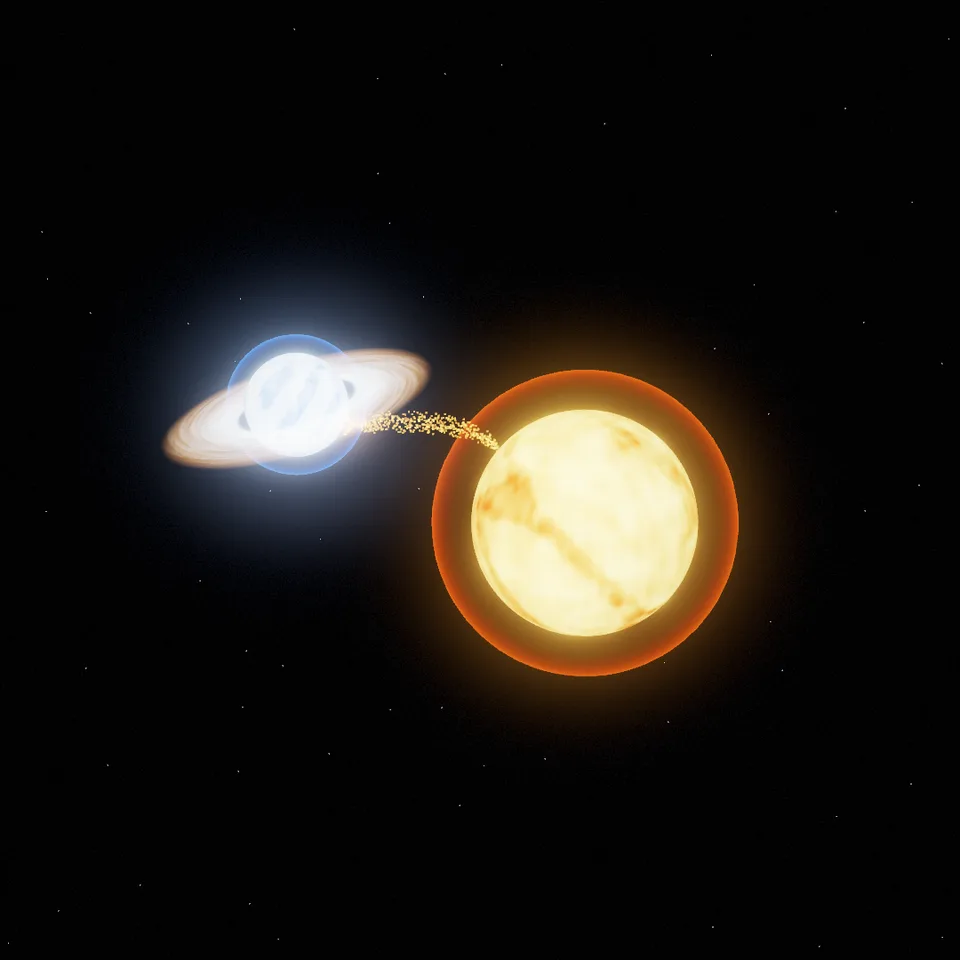
Two stars in orbit, a stream of plasma pulled between them and spiralling into a glowing disc. Loops perfectly.
Next: Blue MarbleSurprise me
Your current settings go with it. Combine several clips and hand them over together from your sequence.
Presets
The preview runs the same code your AI receives. These settings travel with the hand-off.
Two stars locked in orbit about their common centre: a large, cool, boiling orange giant and a small, hot blue companion wearing a spinning accretion disc, with a bright stream of plasma pulled across the gap and spiralling into the disc, against a field of distant stars. The surfaces churn with granulation and spots, the coronas flare, the disc swirls. Choose the star colours (classic, twin, ember or jade), how many orbits a loop holds, how much plasma flows, the disc and the seed.
src/binary-stars.js is the ingredient your AI reuses. demo.js is only the example scene around it, and uses the demo harness only for the demo.
src/binary-stars.jscreateBinaryStars({ palette?, orbits?, stream?, disc?, seed? }) => { group, setProgress(progress), dispose() }createBloomPass(renderer, { width, height, glow?, exposure?, grain? }) => { render(scene, camera, output?), dispose() }PALETTES: { classic, twin, ember, jade }three@0.185.1 (source) — Renderer, geometry and shader materials.apw-runtime@1.0.0 (demo) — Demo harness.Coordinates: The centre of mass is the origin; the giant (radius 1.15) orbits at 1.5 and the companion (0.62) at 3.1 in the xz plane; the camera looks down at about 22°.
Lighting: Self-lit shaders; the bloom gives the coronas and the glare.
Timing: setProgress(progress) places the stars, the plasma and the swirl; frames render in any order.
npm install
npm run render -- binary-stars/1.0.0 --out my-video.mp4
Needs Node 18+, ffmpeg and Chrome/Chromium. Add --params my-settings.json (from Copy settings) for your own settings.sha256:dda611d6d9047247…3D object3DSeamless loop16 seconds
Effect2DSeamless loop6 seconds

Background3DSeamless loop12 seconds
Background3DSeamless loop12 seconds
Background3DSeamless loop12 seconds
Background3DSeamless loop12 seconds
Background3DSeamless loop14 seconds
Background3DSeamless loop16 seconds