Hawking Radiation
Background3DSeamless loop16 seconds
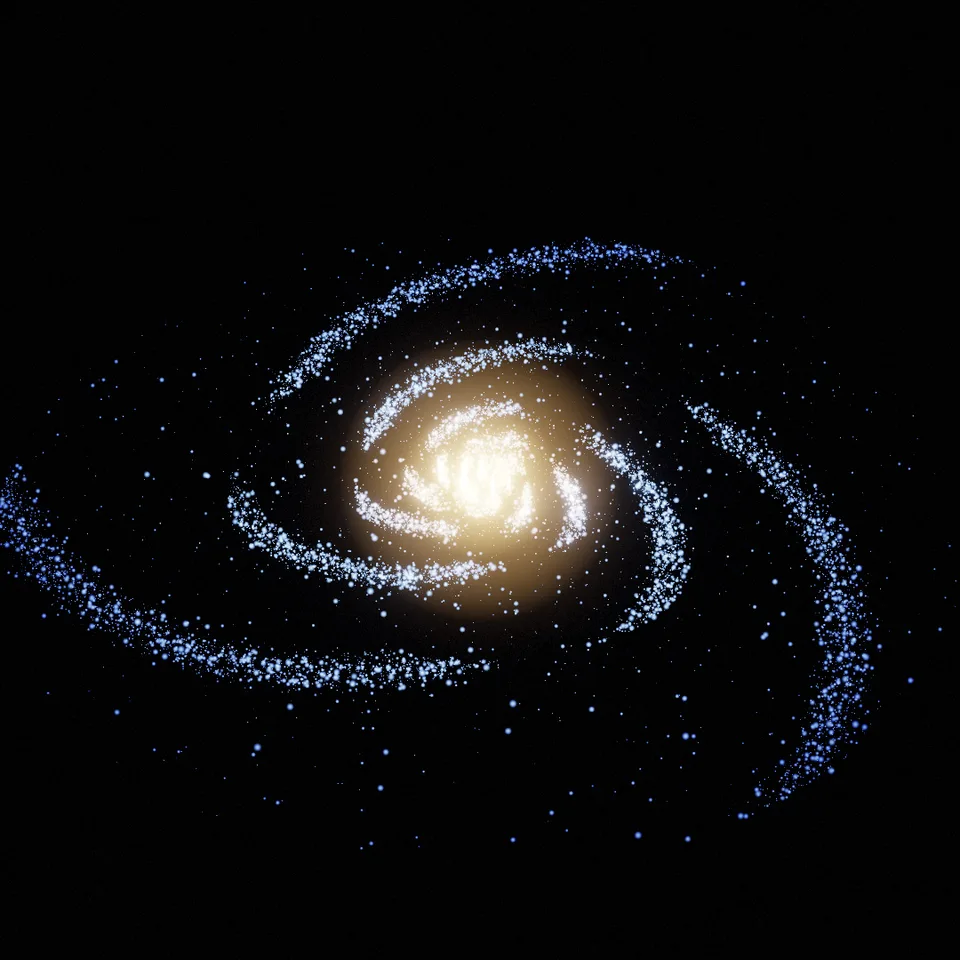
A spiral galaxy of tens of thousands of glowing stars turning with differential rotation: the inner stars lap the outer ones. Loops perfectly.
In Science & maths, Space & cosmos, Light, glass & shine, Patterns & illusions
Your current settings go with it. Combine several clips and hand them over together from your sequence.
Presets
The preview runs the same code your AI receives. These settings travel with the hand-off.
A spiral galaxy of tens of thousands of glowing particles. Stars are scattered along logarithmic arms round a hot core, golden near the middle and blue-white in the arms, with a thin disc of haze, and the whole galaxy turns with differential rotation: the inner stars lap the outer ones, so the arms wind and unwind as it goes. Choose the number of stars, the number of arms, the colours (classic, rose, emerald or mono), how tightly the arms wind, how many laps the outer stars make per loop, the seed and whether the camera sways.
src/particle-galaxy.js is the ingredient your AI reuses. demo.js is only the example scene around it, and uses the demo harness only for the demo.
src/particle-galaxy.jscreateParticleGalaxy({ stars?, arms?, palette?, twist?, laps?, seed? }) => { group, setProgress(progress), setView(heightPx, fovDeg), dispose() }createBloomPass(renderer, { width, height, glow?, exposure?, grain? }) => { render(scene, camera, output?), dispose() }PALETTES: { classic, rose, emerald, mono }three@0.185.1 (source) — Renderer, points and shader materials.apw-runtime@1.0.0 (demo) — Demo harness.Coordinates: The galaxy lies in the xz plane centred on the origin, stars out to a radius of 8; the camera looks down at about 36° from 28 away.
Lighting: Self-lit additive points; the bloom gives the glow.
Timing: setProgress(progress) sets one uniform; the star positions are worked out in the vertex shader; frames render in any order.
npm install
npm run render -- particle-galaxy/1.0.0 --out my-video.mp4
Needs Node 18+, ffmpeg and Chrome/Chromium. Add --params my-settings.json (from Copy settings) for your own settings.sha256:64a097fe1b4c9373…Background3DSeamless loop16 seconds
Effect2DSeamless loop6 seconds
Background3DSeamless loop12 seconds

Background3DSeamless loop10 seconds
Background3DSeamless loop12 seconds
Background3DSeamless loop12 seconds

Effect2DSeamless loop8 seconds
3D object3DSeamless loop16 seconds