Plasma Ball
3D object3DSeamless loop12 seconds
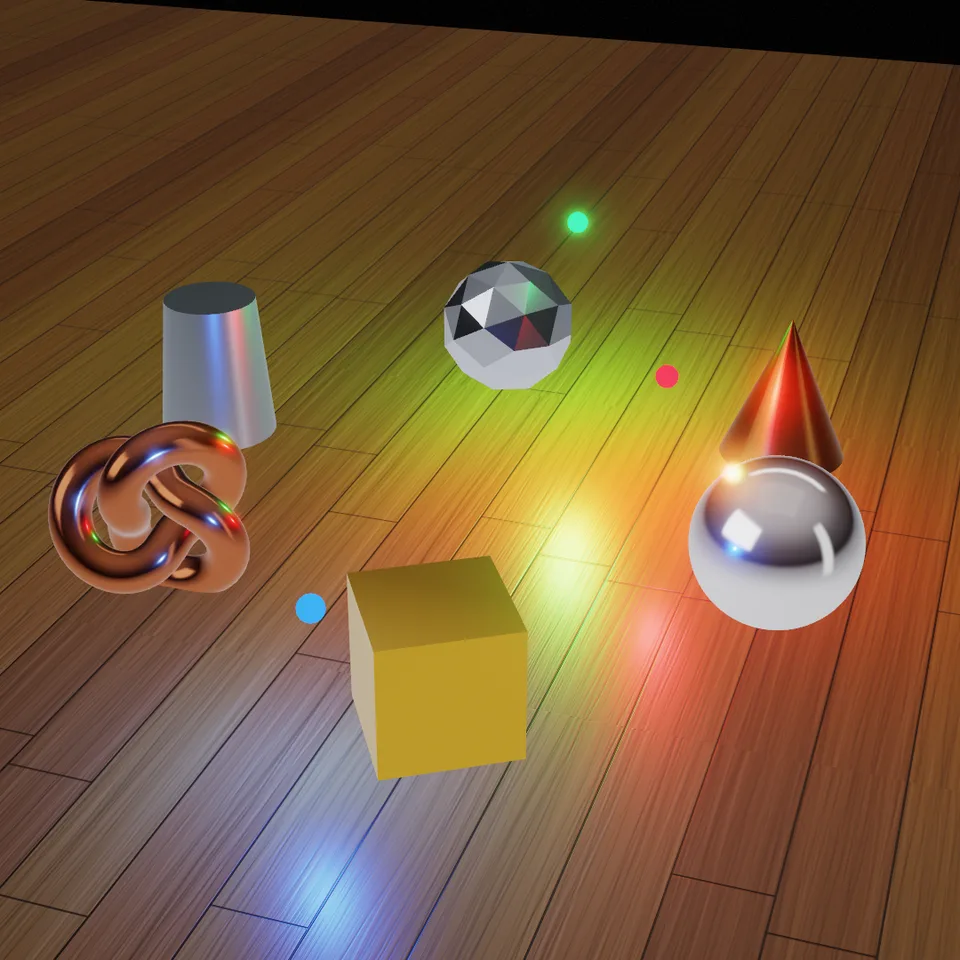
Coloured point lights circling over a polished wooden floor and a ring of metal objects, with bloom. Loops perfectly.
In Space & cosmos, Light, glass & shine
Next: Plasma BallSurprise me
Your current settings go with it. Combine several clips and hand them over together from your sequence.
Presets
The preview runs the same code your AI receives. These settings travel with the hand-off.
Coloured lights circling over a polished wooden floor and a ring of metal objects. Real point lights (red, green and blue by default, with physically based falloff) orbit at different heights and speeds; where their pools overlap on the boards the colours mix, on the metal they slide across as sharp coloured reflections, and each light is a small glowing bead that blooms. Choose the number of lights, the colours (rgb, warm, cool or neon), the objects (mixed metals or all spheres), how strong the lights are, the base laps per loop, the seed, and whether the camera sways.
src/physical-lights.js is the ingredient your AI reuses. demo.js is only the example scene around it, and uses chrome-material only for the demo.
src/physical-lights.jscreateLightShow({ lights?, palette?, objects?, power?, laps?, seed? }) => { group, setProgress(progress), dispose() }createBloomPass(renderer, { width, height, glow?, exposure?, grain? }) => { render(scene, camera, output?), dispose() }PALETTES: { rgb, warm, cool, neon }three@0.185.1 (source) — Renderer, geometry and shader materials.chrome-material@1.1.0 (demo) — Studio environment light, backdrop and contact shadow.apw-runtime@1.0.0 (demo) — Demo harness.Coordinates: The floor (60 across) lies on y = 0; the objects stand in a ring of radius 4.6–5.1; lights orbit at radii 2.2–6.5 and heights 2.4–3.3.
Lighting: Up to six physically based point lights (decay 2) plus a faint studio environment for the metals; each light carries a self-lit bead.
Timing: setProgress(progress) places each light and turns each object; frames render in any order.
npm install
npm run render -- physical-lights/1.0.0 --out my-video.mp4
Needs Node 18+, ffmpeg and Chrome/Chromium. Add --params my-settings.json (from Copy settings) for your own settings.sha256:a099d6fc78ea458b…3D object3DSeamless loop12 seconds
3D object3DSeamless loop16 seconds
3D object3DSeamless loop12 seconds
3D object3DSeamless loop16 seconds
3D object3DSeamless loop16 seconds
3D object3DSeamless loop12 seconds
3D object3DSeamless loop16 seconds
3D object3DSeamless loop16 seconds